STH service

Market background and regulation

Market background and regulation

Providing context for business decision makers.

The core issue

Securities market communication remains highly fragmented, often relying on bilateral agreements, PDF attachments, and manual workflows—making it slow, difficult to audit, and increasingly risky under a T+1 settlement cycle.

Why is change necessary?

Current operation:

  • not uniform
  • manual parts
  • difficult to audit
  • not suitable for supporting T+1 operations

Market and regulatory background

ESMA aims to harmonise the European market by introducing the T+1 settlement cycle. This requires fast, standardised, automated and auditable communication between market participants.

Possible solutions

  • SWIFT-based operation: standardized and reliable, yet costly, complex, and slow to implement for many participants.
  • Custom solutions (e.g., SFTP): technically simple, yet prone to point-to-point connections, different data models, and cumbersome auditing.
  • Central hub model: unified communication platform, standard data structure, scalable architecture and full auditability.
STH messaging service

The STH service

Broad presentation of the solution

The STH solution

The SecuritiesTransferHub connects participants as a central service. STH does not access the content of the business payload, but provides secure message envelope, encryption, signing, delivery, status tracking and auditability.
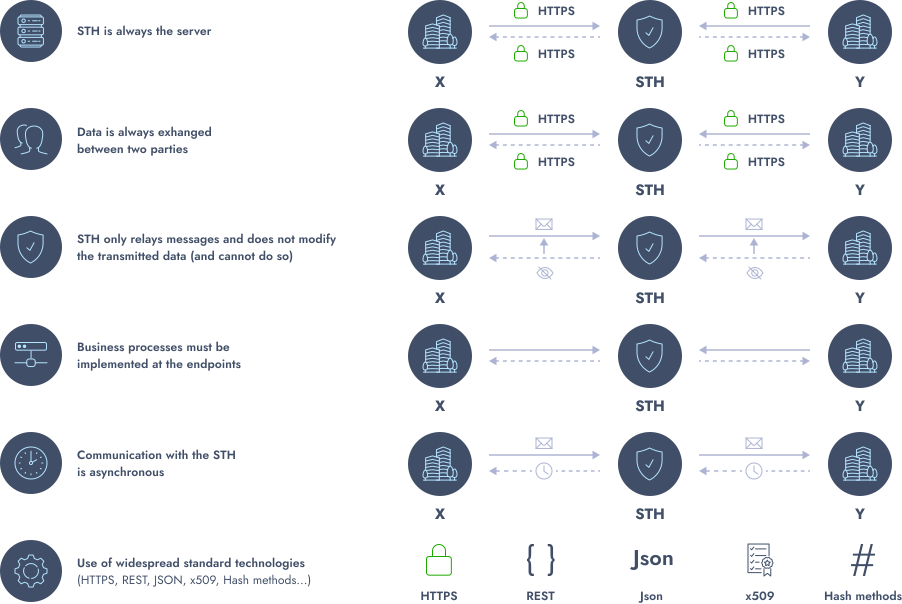

STH central messaging model connecting participating partners

Business benefits of STH

  • Faster settlement
  • Transparent operation
  • Regulatory compliance
  • Cost reduction
  • Better customer experience
  • Automated operation

Who is it recommended for?

  • Investment service providers
  • Fund managers
  • Custodians
  • Treasury service providers
  • Financial infrastructure participants

Main functions

  • Message sending and querying via REST API.
  • HTTPS / mTLS encrypted connection.
  • Message lifecycle statuses: accepted, delivered, client_received, acked, nacked, duplicate, poll_timeout.
  • Certificate management.
  • Participants and premission registry.
  • Message delivery rules.
  • Alerts, reports, statistics.
  • Online admin and customer interface.
  • Optional STH client for internal integrations.
Direct messaging and broadcasting

Direct Messaging and Broadcasting

One-to-one and one-to-many message delivery

Direct Messaging and Broadcasting

With SecuritiesTransferHub, users can send direct messages to individual partners or distribute messages to multiple recipients simultaneously using broadcast messaging.

STH enables organizations to send any type of message to their partners through a secure, encrypted, and fully auditable communication channel. The platform is suitable not only for T+1-related communication but for virtually any business purpose.
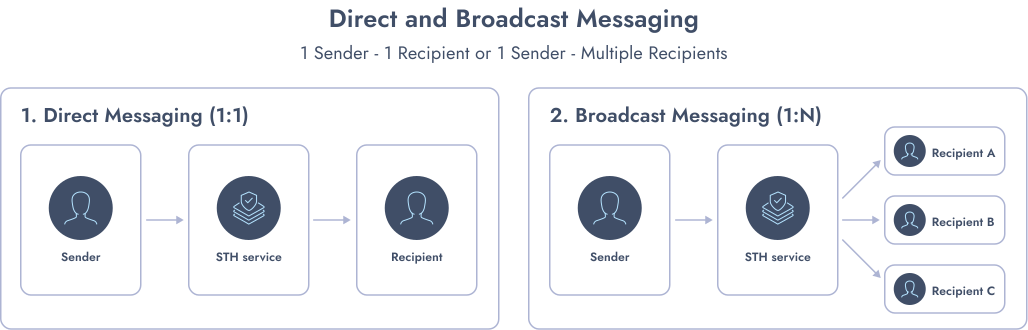

Comparison of direct and broadcast messaging

Direct Messaging

  • 1 sender - 1 recipient
  • Only the recipient can view the business content.

Broadcast Messaging

  • 1 sender - Multiple recipients
  • A single message can be sent to all partners simultaneously.
  • All recipients receive the same business content.
  • Only the intended recipients can view the business content.
Private and secure communication

Technology and security

Bank-grade security and modern architecture
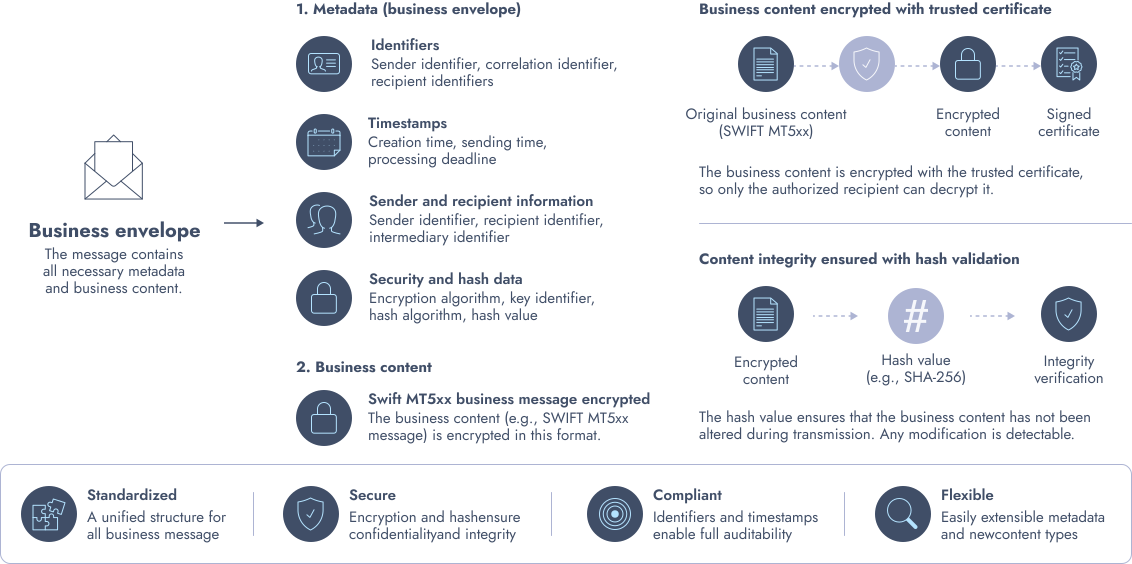
Security principles

  • Confidentiality: Only authorized recipients can access messages.
  • Integrity: The system ensures that the content of messages cannot be modified without being noticed.
  • Auditability: All transactions are logged and traceable.
  • Availability: Sent messages reach the recipient using guaranteed delivery mechanisms.

Structure of an STH message envelope

Encryption and digital signature

STH uses modern cryptographic solutions:

  • AES-256-GCM payload encryption
  • RSA-OAEP key encryption
  • SHA-256 integrity protection
  • Digital signature
  • mTLS-based authentication

Message security process

  1. The client generates a one-time AES key.
  2. The business payload is encrypted.
  3. The AES key is encrypted using RSA-OAEP.
  4. The message is hashed.
  5. The sender signs the message digitally.
  6. The STH verifies the integrity and signature.

Standards and compliance

STH is built on industry standards:

Area Standard
Cyber ​​security NIS2
Data protection GDPR
Communication NIST SP 800-52
Asynchronous message model AsyncAPI 3.0
API documentation OpenAPI 3
Certificates RFC 5280

Infrastructure background

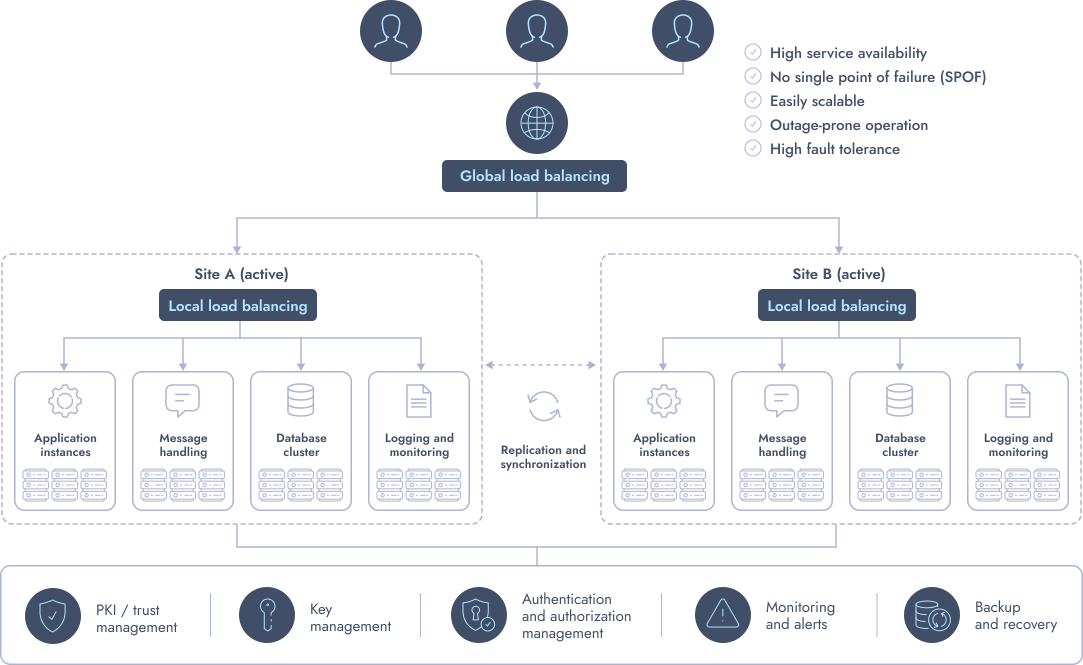
  • Geo-redundant infrastructure
  • Containerized Kubernetes environment
  • High availability
  • Horizontal scalability
  • Audited operation
  • Domestic service provider environment

System architecture of the STH service

API and enterprise integration

API and integration

Detailed integration information for technical decision makers and developers.
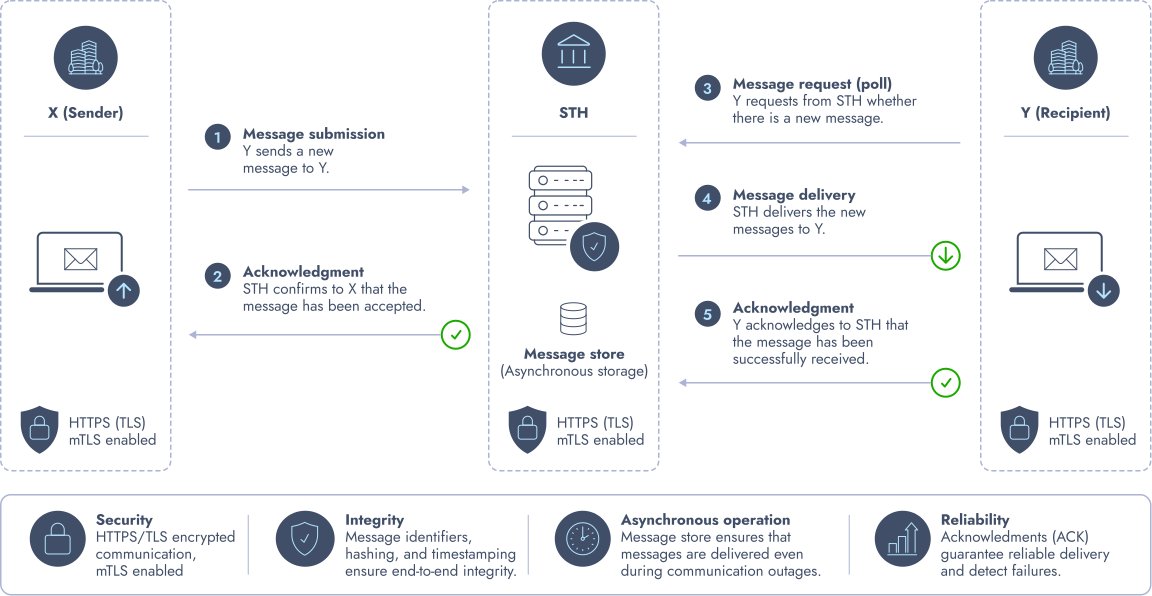
Communication model of the STH API

Communication model

  • REST API
  • HTTPS / mTLS
  • Long-polling based message reception
  • JSON-based message envelope

Message statuses

Status Meaning
accepted Received by server
delivered Sent to recipient
client_received Received by recipient
acked Processing is successful
nacked Processing failed
duplicate Duplicate submission
poll_timeout No new messages

Message envelope fields

  • messageId
  • correlationId
  • senderId
  • receiverId
  • createdAt
  • messageType
  • idempotencyKey
  • security
  • payload

Long-polling operation

STH provides asynchronous messaging:

  • Start a poll request
  • Manage pending messages
  • Manage timeouts
  • Immediate delivery

Payload formats

Supported business content:

  • SWIFT FIN MT5xx
  • JSON
  • XML
  • YAML

Documentation

  • OpenAPI specification
  • AsyncAPI description
  • SDK documentation
  • Code samples
  • Integration guides
Administration and reporting

Admin and reporting

Real-time monitoring, auditability and reporting on a central interface.

Dashboard functions

The admin dashboard provides an overview of:

  • Number of messages sent
  • Processing times
  • Errors and alerts
  • Message statistics
  • Transaction trends

Central admin functions

  • Certificate management
  • Participant registration
  • Entitlement management
  • Message delivery rules
  • Alerts
  • Audit logs

Client functions

  • User management
  • 2FA support
  • Account management
  • Reports and statistics
Onboarding to the STH service

Onboarding

Fast and controlled onboarding process

Steps to join

  1. Contact: Business and technical consultation.
  2. Letter of Intent: Formal confirmation of the participating organization's commitment to join.
  3. Technical Specification: STH provides the necessary interface and integration documentation.
  4. DEV and test environments: Provision of sandbox and mock services.
  5. Integration and UAT tests: Joint testing, validation and load tests.
  6. Launch: Parameterization, certificate management and launch.
  7. Stabilization: Baby-sitting period and release management support.

Developer support

  • Technical Consultation
  • Mock Environments
  • Documentation
  • Operator Support
  • Full Support
STH client application

STH Client

Faster connection, less development required
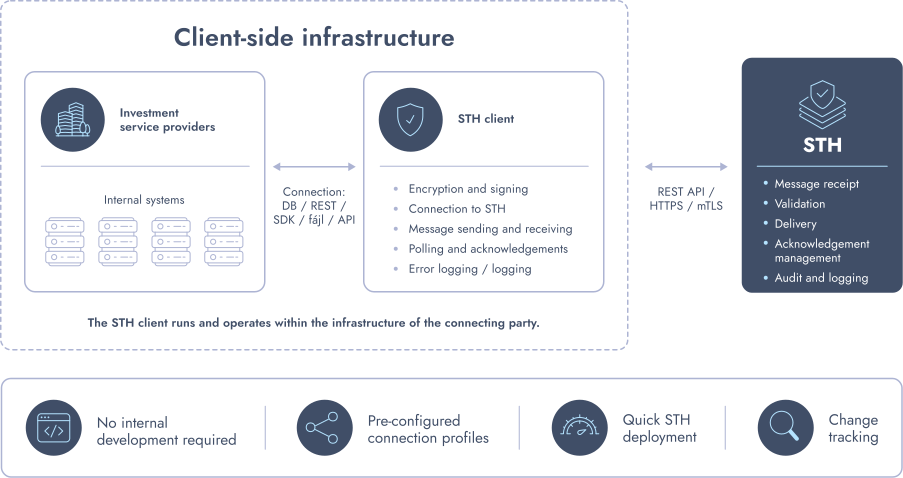
STH client connectivity model

What is STH Client??

An optional software solution that facilitates STH integration.
The STH Client is a containerized SpringBoot-based application that runs within the client's infrastructure.

Core Functionality

  • Connecting to the STH system
  • Encryption and signing
  • Sending and receiving messages
  • Polling and retry handling
  • Logging and reporting

Main benefits

  • Fast onboarding: minimizes the need for internal development.
  • Unified communication: fixed communication and integration modules.
  • Message format conversion: supports transformations to align with internal systems.

Integration options

The STH Client supports several internal interfaces:

  • REST API
  • MQ
  • SDK
  • File based integration
  • Database based integration

Admin functions

  • Message handling
  • Alerts
  • Metrics
  • Reports

BCP support

Manual messaging option if needed.

Technical attributes

  • SpringBoot
  • Containerized operation
  • Angular admin interfaces
  • REST / mTLS communication
  • Minimal resource requirements
  • Scalable operation

Message handling

The STH client admin interface supports:

  • Searching for messages
  • Tracking message lifecycle
  • Displaying statuses
  • Analyzing technical errors
  • Auditing delivery events

Adopt out complete solution and keep your T+1 preparation on track for the 7 December 2026 readiness milestone.

Discuss your T+1 connectivity requirements with our team: